What we lost when home phones left the house
 | March 24, 2026 | 5 min read |
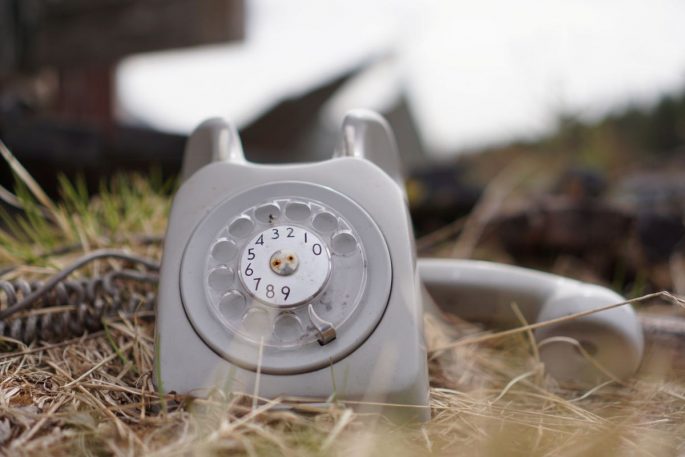
“Don’t talk all night,” dad hollered from the living room as I dragged the bright yellow kitchen phone cord around the corner for a smidge of privacy. “And stop stretching that cord—you’re going to pull the phone off the wall!”
Sigh. It’s hard being a teenager, in any era… especially when the landline phone is the house phone, it’s dinnertime, and the house rule is: we don’t pick up the phone while we’re eating.
If your home phone didn’t have caller ID or voicemail (ours didn’t) you were out of luck guessing who might be trying to reach you. Start to protest, and one of the adults would admonish, “Chew with your mouth closed!”
The landline phone as a communal experience
Yet as frustrating as making and receiving calls on the family phone might have been for teens—or for anyone else who fancied privacy—the fact that conversations happened in shared space also ensured a certain degree of propriety:
- Families knew who was calling.
- Kids learned phone etiquette by watching and listening to their elders (who hopefully had good telephone manners).
- There was no mindless doomscrolling in bedrooms.
The house phone, by definition, belonged to the home, not to a specific individual. A single, stable number with a ringtone everyone recognized meant reliability in an emergency. In addition, one number that was easy for both youngsters and seniors to memorize was a boon for multigenerational homes, which used to be quite common and are making a comeback.
The house phone also conferred built-in boundaries that we didn’t appreciate back then:
- If you were out shopping, or at your daughter’s soccer practice, you couldn’t be reached by phone.
- When you were somewhere other than the house, conversations took place in person.
- You had clear work/life separation—the odds of your boss calling you on the house phone at night were vanishingly small.
- Screen time might have meant watching TV, though no one used such terminology back in the days of the old landline phone.
- When you were with family members, a communal experience did not mean everyone sitting together while using their devices! In a study published by the Journal of Marriage and Family, sociologists have found that families spend at least 30 minutes a day in “alone together time”, where everyone is gazing at the remote world in their hands rather than connecting with each other. Parents of course are finding this disconcerting.
Calling with intention: landline vs. cell phone
When house phones ruled, “butt dialing” didn’t exist. A phone call was intentional: you chose to call someone and committed to having a conversation. You might have spoken with another person in order to reach the one you wanted (“Hello, Mrs. Ames, this is Julie. Is Marybeth there?”). Such interaction was natural and expected. And maybe another opportunity for connection, as you tell your friend’s mom, “My whole family loved the cinnamon cookies you taught me to bake!”
Phone calls mattered. And just as people used to dress up for air travel in a bygone era, long-distance calls once felt important, and somewhat formal. Sometimes they even changed the course of history.
But those long-distance calls were expensive. One dear older friend couldn’t quite grasp how a prepaid cell phone plan included calls anywhere in the country. With her landline, she got charged by the minute for a long-distance call. When I’d call her landline phone from my cell, she’d exclaim, “This call must be costing you a fortune!”
Imagine texting someone like that: an erudite elder who wrote elegant letters longhand and could quote poetry as easily as some of us today quote song lyrics. Even if she’d mastered smartphone usage, so much would be lost: nuance, grace, hearing her voice fill with delight at a call from me.
What we gained with landline alternatives
To be fair, however: mobility and instant access, regardless of where you live, are pretty much requirements in today’s nanosecond world. Family communication happens via text or mobile calls much more frequently than on a landline—witness the number of people in the supermarket with an ear speaker, asking the person on the other end what they’d like for dinner.
This is life in the third millennium. Micro-communication such as direct messaging and push notifications is normal for younger cell phone users, who’ve grown up with digital devices attached to their palms.
And there is a safety feature in being always accessible: if your son misses the school bus while you’re picking up your daughter from soccer practice, he can ping you to please swing by the school to get him before heading home.
To help reduce screen time, your family can try a digital detox and become reacquainted with your house phone—as well as with digitally devoted family members, some of whom may not have looked up in years.
Bringing it home: house phones are becoming popular again
Like multigenerational households, the landline phone is enjoying a revival. However, this time around, the smart money is on VoIP services, which are typically less costly and more effective than traditional landlines. And this time around, no one’s going to tell you not to stretch that cord. It’s your house!
Plus, a VoIP phone gives you the best of both worlds: landline and cell phone, because you can use a mobile app to extend your landline, for example.
It’s like a hybrid car: you use less gas, making it cheaper to operate like an EV, with the ease of refueling that gas cars have (gas stations everywhere).
Why are VoIP phones the new house go-to?
If you’re old enough to remember the Martian-like sounds dial-up modems made when trying to connect to the internet versus the smooth, instantaneous connection we have today, you’ll appreciate that using a VoIP phone is just as easy to use as the old landline—but with perks:
- They’re reliable backup during a power outage. Some even come with a backup battery and failover cell service. If the internet goes down, your VoIP provider, such as Ooma, will automatically reroute calls to a backup number, typically a designated cell phone. We got you!
- It’s a central family number once more.
- Distraction gets discarded. You can build real connection with a house phone again.
- VoIP integrates with a smart home: you keep mobility without losing shared presence. Who says you can’t have it all?
The ring that gathered the house
Speaking of aliens…one of the most emotional movie scenes involving the telephone takes place in the classic, E.T.: The Extraterrestrial, when E.T. points skyward and says, “Phone home!” This moving scene demonstrates that the home phone was never just about who was calling. It was about who was home to receive the call.
What would happen if the house phone started ringing again? Would we receive a call from the stars?
Anything is possible with today’s technology—and that of advanced civilizations. They may be trying to reach us. A VoIP landline might be the device we need now to belong to the house again, as well as to each other, and to a greater collective reality.


Designed with
safety in mind.

S
A
F
E
Husain Sumra is a former journalist who reported on the biggest companies in tech, from Apple to Amazon, covering cloud services, consumer technology and communication solutions. His journalism background has helped him bring a customer-first approach to content marketing, creating pieces of content aimed at helping people.