Which countries invest the most in digital infrastructure?
 | June 16, 2026 | 6 min read |
(Among OECD members and partners)
Every time we send messages, check our bank accounts, make online purchases and update our social media profiles, we depend on digital infrastructure to support it all. These systems are so integrated into daily life now that a lack of access to them can directly affect a person’s economic status
On a larger scale, entire nations depend on the internet to run their governments, making the building and maintaining of these networks a matter of the utmost importance. Despite this being a massive investment, many countries around the globe are pouring immense resources into upgrading their technological capabilities to stay competitive in a rapidly evolving digital world.
Because we know the importance of strong digital infrastructure, the team at Ooma wanted to examine which countries invest the most in it and how that investment affects them.
Why digital infrastructure matters
When you think of infrastructure, you likely envision things like roads, power lines, bridges and the like. Similarly, digital infrastructure is a somewhat broad term that encompasses everything from broadband networks and data centers to cloud systems, mobile connectivity and the servers that support services like AI and social media. According to the World Economic Forum, safe and accessible digital infrastructure is the key to economic development in the modern age. In fact, countries with advanced digital infrastructure have significantly higher GDP growth, so when leaders prioritize these systems or incentivize private businesses to build and maintain them, they are actively supporting their economies and nations as a whole.
This is because strong digital infrastructure allows for higher productivity and better use of existing and future technologies. When communication tools are dependable and digital data can be transferred smoothly without interruption or lag, companies can grow and evolve faster, and remote work or schooling becomes feasible on a large scale. People gain access to a much broader range of information, goods and services. Additionally, easy access helps increase people’s digital skills, making them more valuable to the economy as employees.
At the national level, citizens in highly connected nations have quicker access to government resources and faster communication during emergencies like natural disasters.
Which countries invest the most in technology?
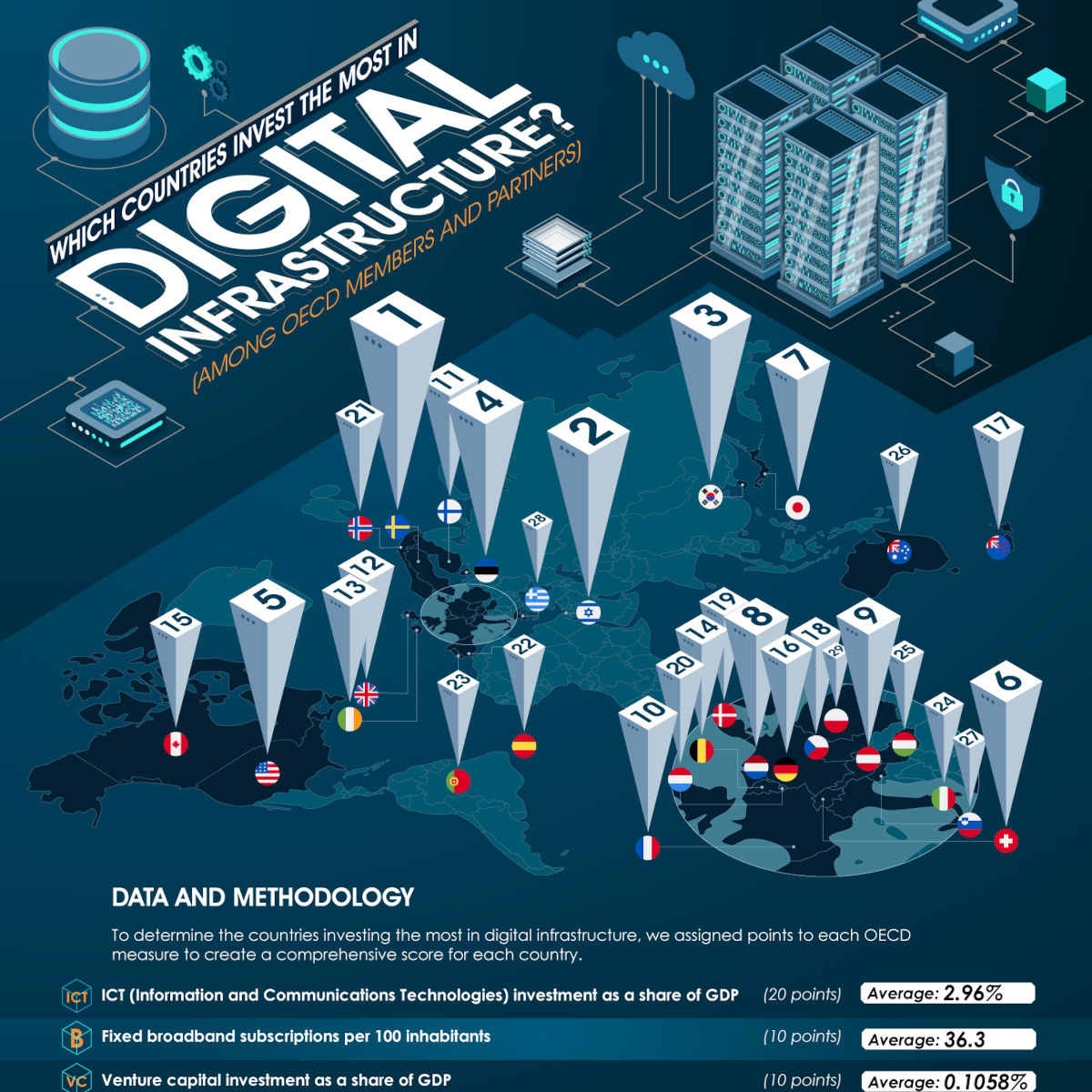
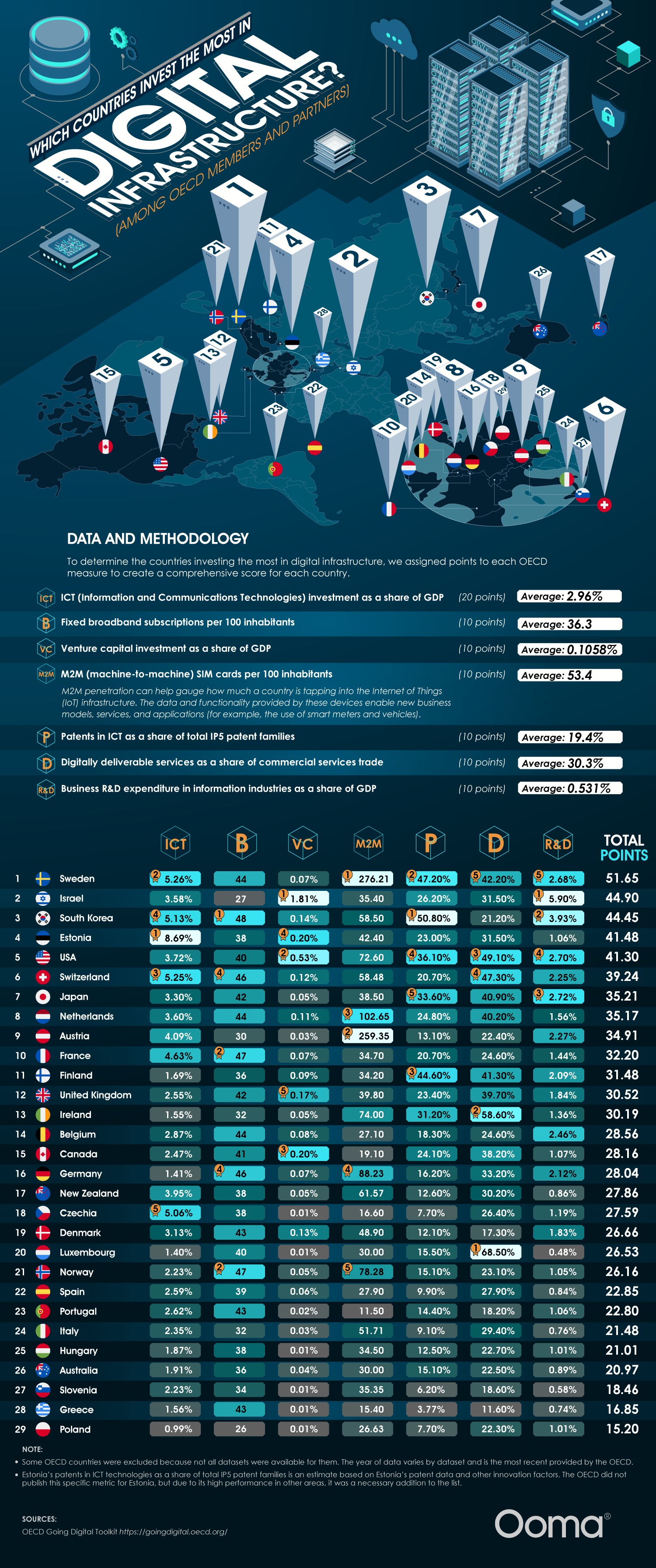
According to the data we found on digital investment by country, Sweden ranks at the top. The Scandinavian nation has scored well across the board, particularly in broadband subscriptions and business research spending. Israel follows closely in second place, standing out largely for its massive venture capital investment relative to gross domestic product and its high concentration of research funding.
South Korea ranks third, fueled by a large number of tech patents and top-tier broadband spread. For those wondering which countries are the most digital, Estonia is frequently cited as a global pioneer, and accordingly, it ranks fourth. The country ranks at the top for investment in information and communications technologies as a percentage of its gross domestic product. The United States rounds out the top five, driven heavily by digitally deliverable services and venture capital.
The impact of global digitization
The effects of digital infrastructure investment are already visible in several leading nations, and Estonia offers one of the clearest examples. Its digital-first approach has enabled nearly all government services, like health care and public assistance, to be delivered online. Each citizen is given a digital ID, which they use for everything from accessing public transport to voting, which they can do from anywhere as long as they have internet access.
Similarly, Sweden has integrated technology into almost every aspect of its society. According to the International Trade Administration, the Swedish electronic commerce market is highly developed, with nearly all households having reliable internet access. This widespread connectivity has turned Stockholm into a major European hub for finance companies.
In Israel, the government established the National Digital Agency, which promotes and supports digital development in the public sector, while the Digital Israel initiative has been integrating digital technology across sectors like education, government and health care. As a result, the Israeli tech sector continues to attract startups and support the growth of its economy.
South Korea’s investments have produced one of the fastest and most reliable internet infrastructures in the world, allowing for immense growth in digital services. This level of connectivity has made South Korea a dominant force in consumer electronics, competitive gaming and semiconductor manufacturing. Recent initiatives have also increased access to broadband internet at a minimum speed of 100 megabits per second for every new household, helping to prevent the digital divide so common even in highly developed nations. That said, the country has unfortunately been vulnerable to numerous cyberattacks, which have marred its reputation in the digital community.
The data clearly show that countries investing in tech infrastructure are the ones that will continue to succeed in the global market. Businesses operating within these countries reap the benefits of high-speed communication and a digitally literate workforce. Every company deserves to experience that same level of seamless connectivity, regardless of its location. That’s why Ooma provides powerful Voice Over Internet Protocol (VoIP) communication solutions designed to keep your team connected and your business moving forward. Contact us today to learn how upgrading your phone or internet systems can help your business communications.
Digital innovation by country
Data and methodology
To determine the countries investing the most in digital infrastructure, we assigned points to each OECD measure to create a comprehensive score for each country.
ICT (Information and Communications Technologies) investment as a share of GDP (20 points)
Average: 2.96%
Fixed broadband subscriptions per 100 inhabitants (10 points)
Average: 36.3
Venture capital investment as a share of GDP (10 points)
Average: 0.1058%
M2M (machine-to-machine) SIM cards per 100 inhabitants (10 points)
M2M penetration can help gauge how much a country is tapping into the Internet of Things (IoT) infrastructure. The data and functionality provided by these devices enable new business models, services and applications (for example, the use of smart meters and vehicles).
Average: 53.4
Patents in ICT as a share of total IP5 patent families (10 points)
Average: 19.4%
Digitally deliverable services as a share of commercial services trade (10 points)
Average: 30.3%
Business R&D expenditure in information industries as a share of GDP (10 points)
Average: 0.531%
| Country | ICT investment as a share of GDP | Fixed broadband subscriptions per 100 inhabitants | Venture capital investment as a share of GDP | M2M SIM cards per 100 inhabitants | Patents in ICT as a share of total IP5 patent families | Digitally deliverable services as a share of commercial services trade | Business R&D expenditure in information industries as a share of GDP | Total points |
|---|---|---|---|---|---|---|---|---|
| Sweden | 5.26% | 44 | 0.07% | 276.21 | 47.20% | 42.20% | 2.68% | 51.65 |
| Israel | 3.58% | 27 | 1.81% | 35.4 | 26.20% | 31.50% | 5.90% | 44.9 |
| South Korea | 5.13% | 48 | 0.14% | 58.5 | 50.80% | 21.20% | 3.93% | 44.45 |
| Estonia | 8.69% | 38 | 0.20% | 42.4 | 23.00% | 31.50% | 1.06% | 41.48 |
| United States | 3.72% | 40 | 0.53% | 72.6 | 36.10% | 49.10% | 2.70% | 41.3 |
| Switzerland | 5.25% | 46 | 0.12% | 58.48 | 20.70% | 47.30% | 2.25% | 39.24 |
| Japan | 3.30% | 42 | 0.05% | 38.5 | 33.60% | 40.90% | 2.72% | 35.21 |
| Netherlands | 3.60% | 44 | 0.11% | 102.65 | 24.80% | 40.20% | 1.56% | 35.17 |
| Austria | 4.09% | 30 | 0.03% | 259.35 | 13.10% | 22.40% | 2.27% | 34.91 |
| France | 4.63% | 47 | 0.07% | 34.7 | 20.70% | 24.60% | 1.44% | 32.2 |
| Finland | 1.69% | 36 | 0.09% | 34.2 | 44.60% | 41.30% | 2.09% | 31.48 |
| United Kingdom | 2.55% | 42 | 0.17% | 39.8 | 23.40% | 39.70% | 1.84% | 30.52 |
| Ireland | 1.55% | 32 | 0.05% | 74 | 31.20% | 58.60% | 1.36% | 30.19 |
| Belgium | 2.87% | 44 | 0.08% | 27.1 | 18.30% | 24.60% | 2.46% | 28.56 |
| Canada | 2.47% | 41 | 0.20% | 19.1 | 24.10% | 38.20% | 1.07% | 28.16 |
| Germany | 1.41% | 46 | 0.07% | 88.23 | 16.20% | 33.20% | 2.12% | 28.04 |
| New Zealand | 3.95% | 38 | 0.05% | 61.57 | 12.60% | 30.20% | 0.86% | 27.86 |
| Czechia | 5.06% | 38 | 0.01% | 16.6 | 7.70% | 26.40% | 1.19% | 27.59 |
| Denmark | 3.13% | 43 | 0.13% | 48.9 | 12.10% | 17.30% | 1.83% | 26.66 |
| Luxembourg | 1.40% | 40 | 0.01% | 30 | 15.50% | 68.50% | 0.48% | 26.53 |
| Norway | 2.23% | 47 | 0.05% | 78.28 | 15.10% | 23.10% | 1.05% | 26.16 |
| Spain | 2.59% | 39 | 0.06% | 27.9 | 9.90% | 27.90% | 0.84% | 22.85 |
| Portugal | 2.62% | 43 | 0.02% | 11.5 | 14.40% | 18.20% | 1.06% | 22.8 |
| Italy | 2.35% | 32 | 0.03% | 51.71 | 9.10% | 29.40% | 0.76% | 21.48 |
| Hungary | 1.87% | 38 | 0.01% | 34.5 | 12.50% | 22.70% | 1.01% | 21.01 |
| Australia | 1.91% | 36 | 0.04% | 30 | 15.10% | 22.50% | 0.89% | 20.97 |
| Slovenia | 2.23% | 34 | 0.01% | 35.35 | 6.20% | 18.60% | 0.58% | 18.46 |
| Greece | 1.56% | 43 | 0.01% | 15.4 | 3.77% | 11.60% | 0.74% | 16.85 |
| Poland | 0.99% | 26 | 0.01% | 26.63 | 7.70% | 22.30% | 1.01% | 15.2 |
Note:
- Some OECD countries were excluded because not all datasets were available for them. The year of data varies by dataset and is the most recent provided by the OECD.
- Estonia’s patents in ICT technologies as a share of total IP5 patent families is an estimate based on Estonia’s patent data and other innovation factors. The OECD did not publish this specific metric for Estonia, but due to its high performance in other areas, it was a necessary addition to the list.
Source:
OECD Going Digital Toolkit https://goingdigital.oecd.org/
Husain Sumra is a former journalist who reported on the biggest companies in tech, from Apple to Amazon, covering cloud services, consumer technology and communication solutions. His journalism background has helped him bring a customer-first approach to content marketing, creating pieces of content aimed at helping people.